Stack, Topple, Repeat: What Wooden Blocks Are Actually Teaching Your Child's Brain
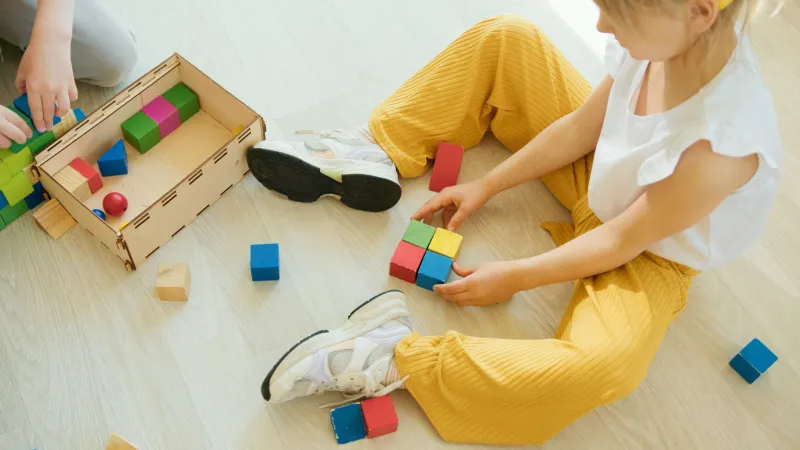
There's a good chance you've stepped on one in the dark. That small, smooth wooden cube hiding under the couch cushion, the rectangular piece wedged behind the radiator. Wooden blocks have a way of spreading through a home like they own the place — and honestly? Maybe they should.
Because while they look like the most low-tech toy on the market, researchers who study how kids grow and learn say wooden blocks are doing something remarkable every single time your child picks one up. The benefits go way beyond keeping little hands busy for twenty minutes. We're talking about the kind of brain-building that shapes how a child thinks, solves problems, and creates — for the rest of their life.
What's Actually Happening When Kids Build
When a three-year-old stacks blocks into a tower, they're not just playing. They're running a series of mental experiments in real time. Will this wide block balance on top of that narrow one? What happens if I put the heaviest piece at the top? Why did it fall that way?
Child development specialists call this kind of thinking causal reasoning — the ability to connect actions with outcomes and adjust behavior based on what you observe. It's a foundational cognitive skill, and block play is one of the earliest and most natural ways kids develop it.
Dr. Kathleen Hirsh-Pasek, a psychology professor at Temple University and one of the leading researchers on play-based learning, has long argued that open-ended construction play activates parts of the brain that structured, screen-based activities simply can't reach in the same way. "Play is the work of childhood," she's said in multiple interviews. And block play, in particular, is some of the most productive work a young child can do.
The Spatial Reasoning Connection
Here's where things get really interesting. Spatial reasoning — the ability to mentally visualize and manipulate objects in three-dimensional space — is one of the strongest predictors of success in STEM fields. And study after study has linked early block play to stronger spatial skills later in life.
A landmark study published in the journal Child Development found that children who engaged in more complex block play at age four demonstrated significantly better spatial reasoning abilities by age five. That gap didn't close on its own — it followed kids into elementary school and beyond.
What makes blocks so effective for spatial development? It comes down to the physical, hands-on nature of the activity. When a child picks up a block, turns it, tries it in different orientations, and decides where it fits, they're building a mental map of how objects exist in space. No touchscreen can replicate that tactile, three-dimensional feedback loop. Swiping left on a tablet is a fundamentally different neurological experience than rotating a wooden arch piece and figuring out how it fits into a structure.
Problem-Solving Without a Script
One of the biggest differences between wooden blocks and most modern toys is that blocks come with zero instructions. There's no right answer, no level to complete, no reward sound when you do it "correctly." That open-endedness isn't a design flaw — it's the whole point.
When kids play without a script, they have to generate their own goals. They decide what they're building, figure out how to build it, troubleshoot when it falls apart, and adapt when they run out of the pieces they need. Psychologists call this executive function — the set of mental skills that includes planning, flexible thinking, and self-regulation.
Executive function is basically the brain's management system, and it develops most rapidly between ages three and seven. Kids who get lots of practice with open-ended play during those years show measurably stronger executive function skills — which translates to better focus, more resilience when things get hard, and stronger academic performance down the road.
Blocks don't just entertain kids. They train them.
Language and Social Skills Sneak In Too
Here's a bonus you might not expect: block play is also a powerful driver of language development. When children play with blocks alongside a parent, sibling, or friend, the conversation that naturally emerges is rich with spatial vocabulary — under, beside, taller, wider, balance, collapse. These aren't words kids pick up from a screen. They're learned through doing and talking simultaneously.
Researchers at the University of Delaware found that the amount of spatial language a child hears during the preschool years directly predicts their spatial reasoning ability later on. Playing with blocks together — and narrating what you're doing — is one of the simplest ways to give your child that advantage.
And when blocks come out in a group setting, the social negotiation begins. Who gets the big arch? Can we build one tower together instead of two separate ones? Learning to collaborate, compromise, and share creative vision are social-emotional skills that matter enormously — and block play gives kids a low-stakes arena to practice them.
Why This Matters More Right Now
American kids are spending more time on screens than ever before. The average child under eight now clocks over two hours of screen time per day, according to Common Sense Media. That's not a judgment — parents are exhausted, screens are everywhere, and sometimes survival mode is real. But it does mean that the time kids spend in open-ended, unplugged play has shrunk significantly over the past two decades.
The cognitive skills that block play builds — spatial reasoning, executive function, causal thinking, problem-solving — don't get the same workout from passive screen time. And while educational apps have their place, they tend to guide kids toward predetermined answers rather than letting them wrestle with an open question.
Blocks don't do the thinking for your child. That's exactly what makes them so valuable.
Choosing the Right Blocks (and Getting Out of the Way)
Not all blocks are created equal. Wooden sets with a variety of shapes — arches, cylinders, triangles, flat planks, and cubes — give kids more to work with than a set of identical squares. The more varied the pieces, the richer the problem-solving opportunities.
At Zabawka Shop, we're big fans of classic, well-crafted wooden construction sets — the kind that have been quietly developing young minds for generations. There's a reason these toys have stuck around while countless flashier options have come and gone.
Once you've got a good set, the most important thing you can do is step back. Resist the urge to show your child the "right" way to build something. Let the tower fall. Let them figure out why. That moment of frustration, followed by the spark of a new idea, is exactly where the learning lives.
Stack. Topple. Repeat. It turns out, that's not just play — it's some of the most important work your kid will ever do.