Hands On, Screens Off: What Happens to Kids' Brains When Parents Make the Switch to Physical Play
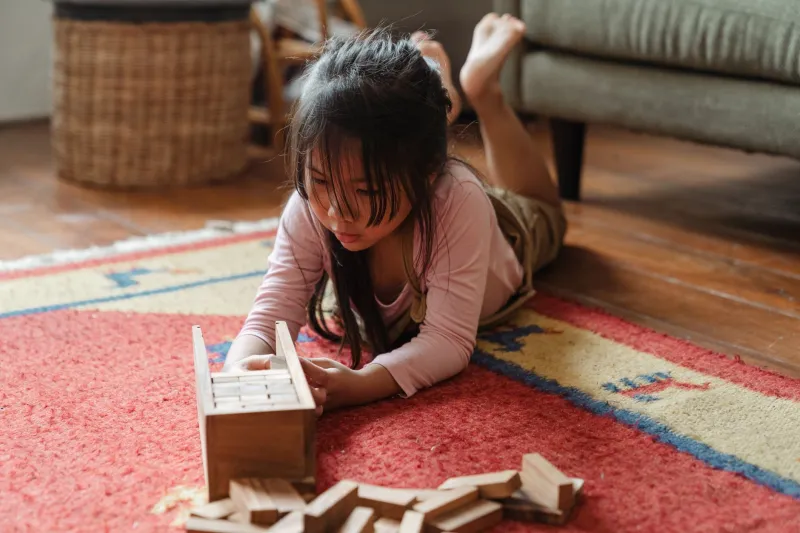
The Quiet Revolution Happening in Living Rooms Across America
It didn't start with a viral parenting post or a pediatrician's stern warning. For a lot of families, it started with a feeling — that nagging sense that handing a kid a tablet was, somehow, a little too easy. Too convenient. That something was being lost in the swipe-and-tap routine that had quietly taken over afternoon hours and weekend mornings.
Across the country, parents are pushing back. Not with grand proclamations or social media manifestos, but with small, deliberate choices: swapping the iPad for a set of building blocks, trading animated apps for a wooden puzzle, or clearing off the coffee table for a proper board game night. Call it the tactile toy renaissance. Call it a screen-free rebellion. Whatever the label, child development researchers say the instinct behind it is spot-on — and the neurological reasons why are more compelling than most parents realize.
What's Actually Happening in a Child's Brain During Hands-On Play
Here's the thing about touchscreens: they're designed to be frictionless. Swipe, tap, watch something happen. It's satisfying in a shallow way, but that ease is precisely the problem. When a child plays with a physical object — a set of magnetic tiles, a lump of modeling clay, a simple wooden train set — their brain is doing something entirely different.
Dr. Elena Marchetti, a developmental psychologist who consults with early childhood educators, puts it plainly: "Physical play activates multiple sensory systems simultaneously. You've got proprioception, fine motor coordination, spatial reasoning, and cause-and-effect thinking all firing at once. A tablet game, no matter how 'educational' the label says it is, simply cannot replicate that cross-sensory engagement."
The cerebellum — the part of the brain responsible for motor control and coordination — develops rapidly in early childhood, and it thrives on tactile input. Squeezing, stacking, threading, pressing, pulling: these aren't just cute toddler activities. They're neural workouts. Research from the University of Virginia found that children who engaged in more hands-on, unstructured physical play showed stronger executive function skills by kindergarten, including better impulse control, working memory, and cognitive flexibility.
Those are the exact skills that help kids sit through a classroom lesson, navigate a disagreement on the playground, and eventually tackle complex problem-solving as adults.
Real Parents, Real Results
At Zabawka Shop, we hear from families all the time who've made this shift — and the stories share a surprising consistency.
Tamara, a mom of three from outside Chicago, described her turning point: "My middle kid, who was six at the time, had basically stopped playing with anything that didn't have a screen. Then we went to a birthday party and the host had set out a big bin of building toys and craft supplies. My son spent two hours completely absorbed. I hadn't seen him that focused in months. That was it for me. We did a major toy overhaul that same week."
She replaced most of the tablet time with open-ended building sets, a set of wooden animal figures, and a rotating selection of age-appropriate puzzles. Within a month, she noticed her son initiating imaginative play on his own — something he hadn't done since he was four.
Marcus, a dad from Austin, had a slightly different experience. His daughter had no trouble with focus, but her ability to play with other kids was suffering. "She was great at solo screen time but kind of lost when it came to playing with her cousins or neighbors. Everything had to have a winner or a clear objective. She didn't know how to just... play." A shift toward cooperative board games and sensory-based toys helped her rebuild those social muscles. "It took a few weeks, but she started inventing games herself, making up rules, including other kids in her ideas. That's the stuff that actually matters."
Why Tactile Toys Build Skills That Apps Can't
It's worth being specific here, because not all screen-free toys are created equal either. The magic ingredient isn't just the absence of a screen — it's the presence of open-ended challenge.
Toys that require a child to figure something out, that don't come with a built-in win condition or a flashing reward animation, are the ones that build genuine cognitive resilience. A puzzle that's slightly too hard. A set of blocks with no instructions. A craft kit where the end result is entirely up to the kid. These experiences teach children to tolerate frustration, experiment with solutions, and feel the intrinsic satisfaction of figuring something out on their own.
This is where tactile toys have a structural advantage over even the most thoughtfully designed educational apps. Apps, by their nature, are designed to keep users engaged — which often means keeping them just satisfied enough to keep tapping. Physical toys don't have an algorithm optimizing for engagement. They just sit there, waiting for a child's imagination to do the heavy lifting.
That's actually a feature, not a bug.
Making the Transition Without the Meltdown
Let's be real: if your kid is used to significant screen time and you suddenly replace it with a box of wooden beads, you're going to have a rough afternoon. The transition works better when it's gradual and, crucially, when parents participate.
Child development specialists consistently emphasize that the most powerful play environment isn't one full of expensive toys — it's one where a caregiver is present and engaged, at least some of the time. You don't have to play every second, but sitting nearby, asking curious questions, or occasionally joining in sends a clear signal that this kind of play is worth doing.
A few practical starting points that families in the Zabawka community have found helpful:
- Start with one screen-free hour per day, ideally at the same time, so it becomes routine rather than a punishment.
- Let kids choose from a curated selection of physical toys rather than dictating what they play with. Agency matters.
- Rotate toys in and out to keep novelty alive. You don't need a roomful of options — just fresh ones.
- Embrace boredom as a feature. That restless "I don't know what to do" moment is often the launchpad for creative play.
The Bigger Picture
None of this is about demonizing technology. Screens aren't going anywhere, and plenty of digital tools have real value in a child's life. But there's a growing consensus among researchers, educators, and parents alike that the balance has tipped too far — and that the skills built through physical, tactile play are too important to crowd out.
Kids who learn to focus on something that doesn't reward them every thirty seconds. Kids who figure out how to entertain themselves, collaborate with siblings, and persist through frustration. Those are the kids who tend to thrive — in school, in friendships, and eventually in whatever comes next.
A good toy doesn't need a charger. It just needs a kid with a little time and space to explore. And honestly? That's been true for a lot longer than tablets have existed.