How Toys Without Instructions Are Quietly Raising Genius Kids
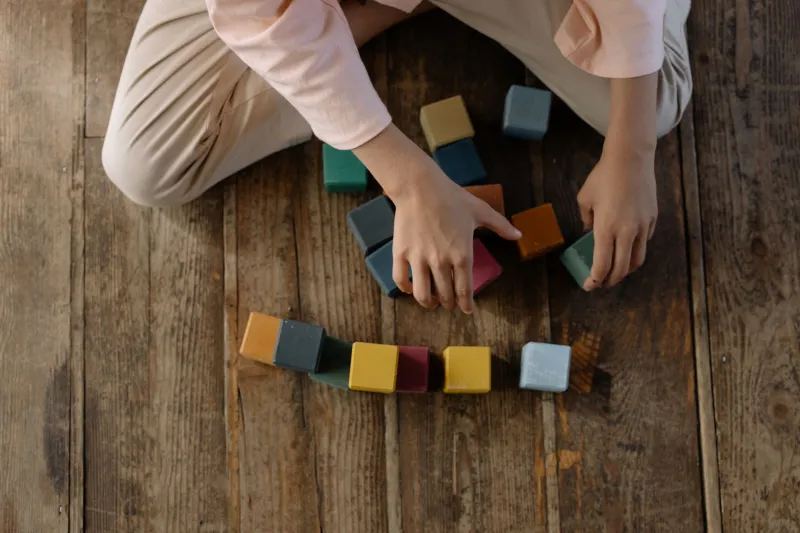
Picture this: your kid gets a shiny new electronic toy for their birthday. It lights up, makes sounds, and guides them through every step. They love it — for about 20 minutes. Then it sits in the corner collecting dust. Sound familiar?
Now picture a simple set of wooden blocks or a bag of colorful loose parts. No instructions. No batteries. No "right" way to play. And somehow, your child is still playing with it an hour later, completely absorbed.
There's actual science behind why that second scenario happens — and why it matters way more than most parents realize.
What Happens in the Brain During Open-Ended Play
Neuroscientists have spent years studying how different types of play affect children's developing brains, and the results are pretty eye-opening. When a child plays with a toy that has a predetermined function — press this button, get that sound — the brain essentially follows a script. It's passive engagement. The toy does the thinking.
But when a child picks up a set of building blocks or a collection of wooden shapes, something entirely different kicks in. The prefrontal cortex — the part of the brain responsible for planning, problem-solving, and creative thinking — lights up. The child has to generate the play themselves. They have to decide what the toy becomes.
Dr. Stuart Brown, founder of the National Institute for Play, has long argued that imaginative, unstructured play is one of the most critical drivers of brain development in early childhood. When kids aren't told what to do with a toy, they activate what researchers call "divergent thinking" — the ability to generate multiple solutions to a single problem. That's the same cognitive skill behind innovation, adaptability, and yes, academic success.
The "Loose Parts" Theory That Changed Toy Design
Back in 1971, architect Simon Nicholson introduced what he called the Theory of Loose Parts. His idea was simple but radical: the more variable and open a toy or environment is, the more creative potential it holds. Fixed, single-purpose objects — no matter how flashy — limit a child's inventiveness. Open-ended materials set it free.
Fast forward to today, and child development experts across the US are applying this theory in classrooms, therapy settings, and even pediatric recommendations. The American Academy of Pediatrics has emphasized the developmental value of play that encourages kids to use their imagination rather than react to pre-programmed stimuli.
Building blocks, construction sets, wooden figures, play sand, magnetic tiles — these are all classic examples of loose parts in action. They can become anything: a castle, a spaceship, a grocery store, a city. The child's brain is the engine, and the toy is just the fuel.
Screen Time vs. Imaginative Play: Finding the Balance
Let's be real — screens aren't going anywhere, and most American families aren't trying to raise kids in a tech-free bubble. The goal isn't to demonize electronic toys or tablets. It's to make sure they don't crowd out the kind of play that actually builds cognitive muscle.
Child psychologist Dr. Kathy Hirsh-Pasek, a professor at Temple University and co-author of Becoming Brilliant, suggests thinking of play as a spectrum. On one end, you have passive consumption — watching videos, following along with a guided app. On the other end, you have active, open-ended creation. Both have their place, but kids need a healthy dose of the latter to develop executive function, emotional regulation, and social skills.
A practical rule of thumb many developmental experts recommend: for every hour of screen-based or guided electronic play, aim for at least an equal amount of unstructured, open-ended play. And the simpler the toy, often the better.
Why Classic Toys Keep Winning
Here at Zabawka Shop, we've always believed that the most enduring toys are the ones that grow with a child. A set of quality wooden blocks doesn't become obsolete when your kid turns six — it just gets used differently. The toddler stacks them. The five-year-old builds elaborate structures. The eight-year-old uses them to map out a neighborhood or recreate a scene from their favorite book.
This kind of longevity isn't just good for your wallet. It's good for your child's development at every stage. Research published in the journal Child Development found that children engaged in open-ended construction play showed stronger spatial reasoning skills — a predictor of later success in STEM fields — compared to peers who primarily played with single-function toys.
There's also an emotional intelligence angle worth mentioning. When kids play with open-ended toys alongside siblings or friends, they have to negotiate, communicate, and collaborate. "I want this to be the bridge." "No, let's make it the wall." That kind of back-and-forth is early training in empathy and social problem-solving — skills no app can teach.
Practical Tips for Parents Shopping Smarter
If you're looking to refresh your child's toy collection with more developmentally rich options, here are a few things to keep in mind:
Prioritize versatility. A good open-ended toy can be used in at least five different ways. If you can only think of one or two uses, keep looking.
Don't underestimate simplicity. A beautifully crafted set of wooden animals or a bag of colorful building pieces doesn't need to do anything special to spark creativity. The magic comes from your child, not the toy.
Mix age ranges. Many open-ended toys are genuinely fun for a wide age range. Magnetic tiles, for example, are beloved by toddlers and 10-year-olds alike — just in very different ways.
Create a "yes space" for messy, open play. Designate an area of your home where your child can spread out, build, experiment, and leave things unfinished. The ability to return to a project and build on it is itself a powerful cognitive skill.
Rotate toys regularly. Having fewer toys available at once — and rotating them every few weeks — actually increases engagement and creativity. Novelty doesn't have to mean new purchases.
The Bottom Line
The research is clear: when kids are handed a toy and told "figure it out," something remarkable happens in their brains. They problem-solve. They imagine. They build — not just towers or castles, but neural pathways that will serve them for life.
At Zabawka Shop, that's exactly the kind of play we're here to support. Whether it's a classic construction set, a set of open-ended wooden pieces, or a simple building kit with endless configurations, the toys we believe in most are the ones that put your child in the driver's seat.
Because the best toy in the room? It's always been your kid's imagination.