Old Toys, New Life: Why Parents Are Raiding the Past to Stock Today's Playrooms
Somewhere between the third broken plastic dinosaur and the fifth dead battery, a lot of American parents are arriving at the same quiet conclusion: maybe the old stuff was better.
Not in a curmudgeonly, "kids these days" kind of way. More like a genuine, curious reckoning with the fact that a set of marbles or a simple spinning top can hold a seven-year-old's attention for an hour straight, while a $60 electronic toy gets abandoned by Tuesday.
Vintage toys are having a serious moment. Estate sales, antique shops, eBay rabbit holes, and family attics are all getting raided in the name of better play. Here's why it's happening — and how to do it well.
What's Driving the Vintage Toy Revival
The short answer is overwhelm. Modern toy culture has become a kind of sensory arms race — louder, flashier, more feature-packed with each product cycle. For a lot of families, the noise has become exhausting. There's a growing hunger for simplicity, and vintage toys deliver it in spades.
Toy historian and author Christine Ferretti, who has spent two decades documenting American play culture, puts it plainly: "Old toys asked something of children. They required imagination, patience, physical skill. The toy itself was only half the equation — the child had to bring the other half."
That dynamic is exactly what's drawing parents back. A set of jacks doesn't tell your kid what to do with it. Neither does a bag of marbles or a cast-iron spinning top. The play is self-directed, open-ended, and — here's the kicker — often more engaging for it.
There's also a social dimension. Vintage games like pick-up sticks, tiddlywinks, or classic card games like Old Maid require players to be present with each other. No screens, no batteries, no tutorial videos required. Just kids, a kitchen table, and a set of rules passed down through generations.
The Toys Making the Biggest Comeback
Marbles might be the most emblematic of the revival. Once a schoolyard staple across America, they nearly vanished from mainstream retail in the 1990s. Now they're back — both as collectibles and as genuine play objects. Kids who encounter them for the first time are almost universally fascinated. The weight, the color, the satisfying click of glass on glass. It's tactile in a way that's genuinely novel to a generation raised on touchscreens.
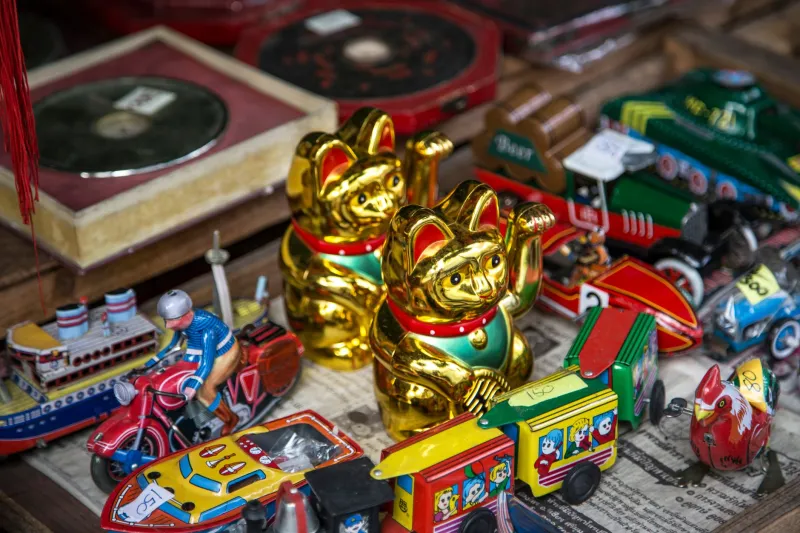
Tin wind-up toys are another favorite. Mid-century tin toys from Japan and Eastern Europe — hopping birds, walking robots, spinning circus performers — are charming, mechanical, and wonderfully mysterious to young children who have never seen a toy move without batteries. Many parents are discovering that a well-made tin toy from the 1950s or '60s still works perfectly after seventy years, which says something about build quality that modern plastic simply can't match.
Classic wooden games — nine men's morris, mancala, peg solitaire — are finding new audiences too. These games have roots that stretch back centuries, and there's something quietly powerful about introducing a child to a game that people were playing a thousand years ago. It situates play in human history in a way that a branded video game tie-in never could.
Vintage board games from the 1950s through the 1980s — original editions of Clue, Sorry!, or Stratego — are showing up at family game nights and holding their own against their updated counterparts. Parents who grew up with these games feel the nostalgia; their kids, encountering them fresh, just see a great game.
Sourcing Vintage Toys Safely
Here's where enthusiasm needs to meet caution. Not all vintage toys are safe for modern children, and it's important to know what you're looking for.
Lead paint is the biggest concern with pre-1978 toys. American regulations around lead in paint changed significantly in the late 1970s, so anything manufactured before that date should be tested before it goes into a child's hands — especially if it shows any paint chipping or wear. Lead test kits are inexpensive and widely available at hardware stores.
Small parts in vintage toys weren't regulated the same way they are today. Marbles, small tin pieces, and vintage game components can be choking hazards for children under three. Keep vintage toys on a separate shelf for older kids, and supervise play with anything that has small components.
Where to shop: Estate sales are goldmines for genuine vintage finds at reasonable prices. Antique malls often have dedicated toy sections, and knowledgeable dealers can help you date pieces accurately. eBay and Etsy are useful but require more due diligence — look for sellers with detailed photos and clear provenance information. Facebook Marketplace and local thrift stores are worth checking regularly; great finds turn up unpredictably.
What to look for: Intact pieces with minimal wear, original boxes when possible (they help with dating and identification), and no strong chemical smell (which can indicate deteriorating materials). For tin toys, avoid anything with significant rust on moving parts, as mechanisms may no longer function safely.
What Kids Actually Get Out of It
Beyond the nostalgia trip for parents, vintage toys offer children something genuinely developmental. Open-ended toys — the kind that don't come with a script — build creativity and problem-solving in ways that highly structured modern toys often don't.
Learning to play jacks, for instance, requires fine motor precision, hand-eye coordination, and patience. It takes most kids a while to get good at it. That process of gradual mastery — trying, failing, trying differently — is exactly the kind of productive struggle that builds resilience.
And there's something to be said for the intergenerational connection these toys carry. When a grandparent can sit down with a grandchild and play the same game they played as a kid, something real passes between them. That's not sentimentality — it's community and continuity, built through play.
At Zabawka Shop, we've always believed that the best toys are the ones that outlast trends. Vintage toys didn't survive decades by accident. They survived because they work — because they meet children where they are and ask them to grow. That's a design principle worth rediscovering.