Buy It Once, Play It Forever: The Real Math Behind Toys That Last Through Every Stage
Buy It Once, Play It Forever: The Real Math Behind Toys That Last Every Stage
There's a particular kind of parent guilt that hits somewhere around the third week of January. The holiday gifts are scattered across the floor, half of them already ignored, and you're doing the math in your head — tallying up what you spent versus what your kid is actually engaging with. If that sounds familiar, you're not alone. American families spend an average of over $500 per year on toys, and a significant chunk of that money ends up in the donation bin before spring.
But here's what's quietly changing: more parents are waking up to a different kind of toy philosophy — one where the question isn't "Will my kid love this?" but "Will my kid still be playing with this in four years?"
That shift in thinking is what some child development researchers are calling the imagination economy — the idea that toys with lasting, evolving value aren't just better for developing minds, they're genuinely better financial investments.
The Problem With Single-Stage Toys
Walk through any big-box toy aisle and you'll notice something: most toys are designed for a very specific window. A shape-sorter for 12 to 18 months. A talking doll for ages 3 to 5. A slime kit for that brief, glorious phase when everything must be slimy. These products aren't bad — they're just narrow.
Single-stage toys serve a purpose, but their shelf life is short by design. Once a child ages out of the developmental sweet spot the toy was built for, it loses its pull. The child moves on. The toy does not.
This is the core inefficiency parents rarely talk about: you're not just buying a toy, you're buying a toy for a version of your child that will exist for maybe 18 months. After that, you're essentially starting from scratch.
What Makes a Toy Truly Adaptable?
Adaptable toys — sometimes called "open-ended" or "multi-stage" toys — are built differently from the ground up. They don't tell a child what to do with them. Instead, they create conditions for play that shift and deepen as the child's abilities grow.
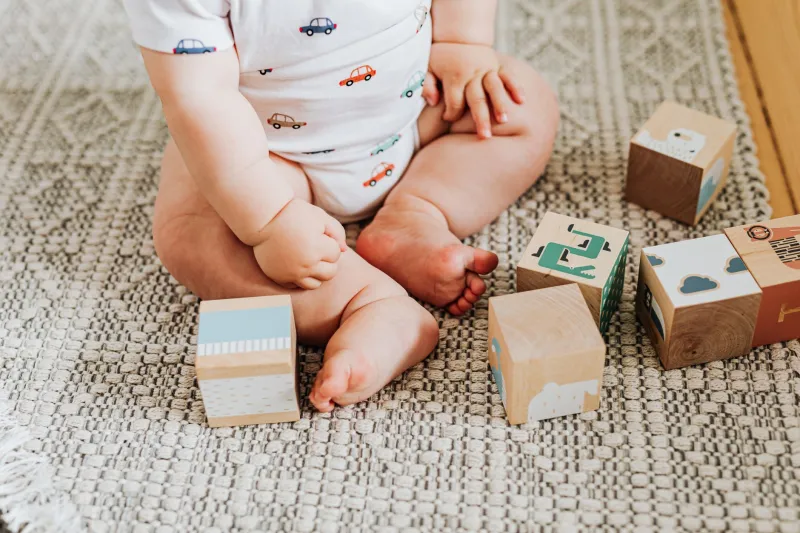
Think about a well-crafted set of wooden building pieces. A two-year-old stacks them, knocks them down, and learns cause-and-effect. A four-year-old builds enclosures and starts narrating stories about the animals inside. A seven-year-old architects entire cities with zoning rules they invented themselves. Same toy. Completely different cognitive engagement at every stage.
Here are a few hallmarks of genuinely adaptable toys:
- No single correct outcome. The toy doesn't have a "win" state or a pre-programmed response. The child defines success.
- Scalable complexity. A beginner can engage simply; an advanced player can go deeper.
- Tactile, physical materials. Wood, fabric, and natural textures tend to outlast plastic both physically and in terms of a child's sustained interest.
- Narrative potential. Toys that can be characters, tools, or settings give kids more imaginative runway.
- Minimal batteries required. Powered toys tend to entertain passively. The child watches. Unpowered toys demand the child participates.
Real Families, Real Numbers
Let's get concrete. Consider a family in Ohio who bought a premium open-ended wooden play set when their daughter was 18 months old. The initial sticker price felt steep — around $85. But that set traveled with her through toddler stacking games, preschool-age pretend play, and eventually became the "building supply" for elaborate construction projects she ran with her younger brother when she was seven.
Compare that to the same family's experience with a battery-powered toy kitchen bought the same year for $60. It was a hit for about five months. Then the novelty wore off, a button stopped working, and it went to Goodwill.
Over six years, the wooden set cost them roughly $14 per year. The kitchen cost $60 for five months of use.
This pattern shows up again and again when parents actually track their toy spending. The upfront cost of a quality, multi-stage toy almost always looks more expensive — and almost always proves cheaper over a meaningful time horizon.
The Psychology of Why Kids Stick With Certain Toys
Child psychologists have a term for what happens when a toy continues to capture a child's attention: sustained engagement through increasing mastery. Basically, kids stay interested in things they haven't fully figured out yet.
Single-function toys get figured out fast. Once a child knows how to make the button play the song, there's nothing left to discover. The toy has given everything it has.
Open-ended toys, by contrast, keep revealing new layers. The challenge scales with the child. There's always a harder version of the game to play, a more complex structure to build, a richer story to tell. That's not an accident — it's design philosophy.
This is why traditional toys from European play traditions, including many you'll find in Polish toy-making culture, have such impressive staying power. They're built around the idea that a toy should challenge a child, not just entertain them — and that the challenge should grow alongside the child.
A Practical Framework for Buying Smarter
So how do you actually identify a toy that will last? Here's a simple filter to run before any purchase:
1. The Three-Age Test Ask yourself: Can I imagine a younger version of my child using this? Can I imagine an older version? If the answer to both is yes, you're probably looking at something with real longevity.
2. The Blank Slate Rule If the toy comes with extensive instructions for how to play with it, that's a yellow flag. The best long-term toys have almost no instructions because the child writes the rules.
3. The Floor Test Imagine the toy sitting on the floor with no adult facilitation. Does your child have to bring something to it — imagination, problem-solving, storytelling? Or does it do everything for them? Toys that require the child to show up tend to stay in rotation longer.
4. Material Quality Check This is practical: a toy that breaks in year one is a single-stage toy regardless of its design intent. Look for solid construction, non-toxic materials, and the kind of craftsmanship that suggests the maker expected it to be played with hard for a long time.
5. The Sibling Factor If you have or plan to have more than one child, multi-stage toys multiply in value. A toy that works for a wide age range means your second and third kids inherit something genuinely useful, not a hand-me-down that's already been outgrown.
The Bigger Picture
There's something worth sitting with beyond the financial argument. When we buy toys that grow with our kids, we're also making a statement about what play is for. We're saying it's not about keeping children occupied — it's about giving them tools to understand and invent their world.
The best toys don't expire. They just change what they're teaching.
And honestly? That's a pretty good deal at any price point.